Can Calm Tingle?
Recognize the small sounds and sensory moments you enjoy, and explore why calm and tingles feel different for each person.
When you’re overworked, overwhelmed, or caught in overthinking, a small pause can feel out of reach. Our ASMR books and free guides help you explore a personal way to unwind, understand the science, and choose experiences you enjoy. Find self-help tools for building a wind-down routine as part of everyday stress management.
Studied for calm. In a 2018 study, people who experienced ASMR reported greater calm while watching ASMR videos. Read the research ↗
Part of BestCareMatch’s care education collection. Our BestCareMatch store handles purchases and downloads of the Science and System PDFs. Why BestCareMatch? ↓
By Sophi Garcia, MD, MLS · Author, developer of the CARE ASMR System, and founder of BestCareMatch.
Individual responses vary. Begin with what feels comfortable for you.

Choose the book that fits your question. The Science and System PDFs are sold through our BestCareMatch store. Can Calm Tingle? is available on Amazon.

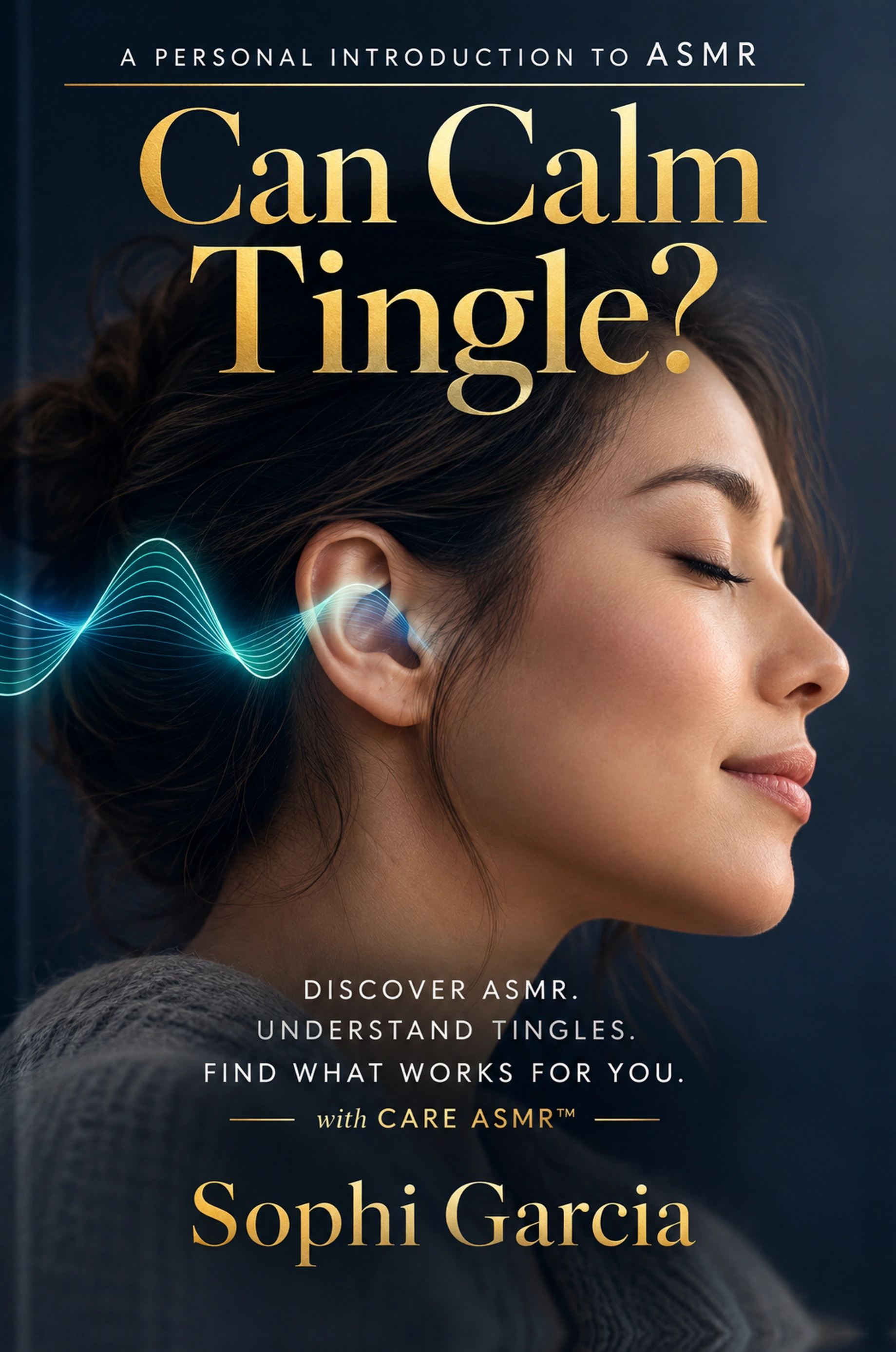
Recognize the small sounds and sensory moments you enjoy, and explore why calm and tingles feel different for each person.

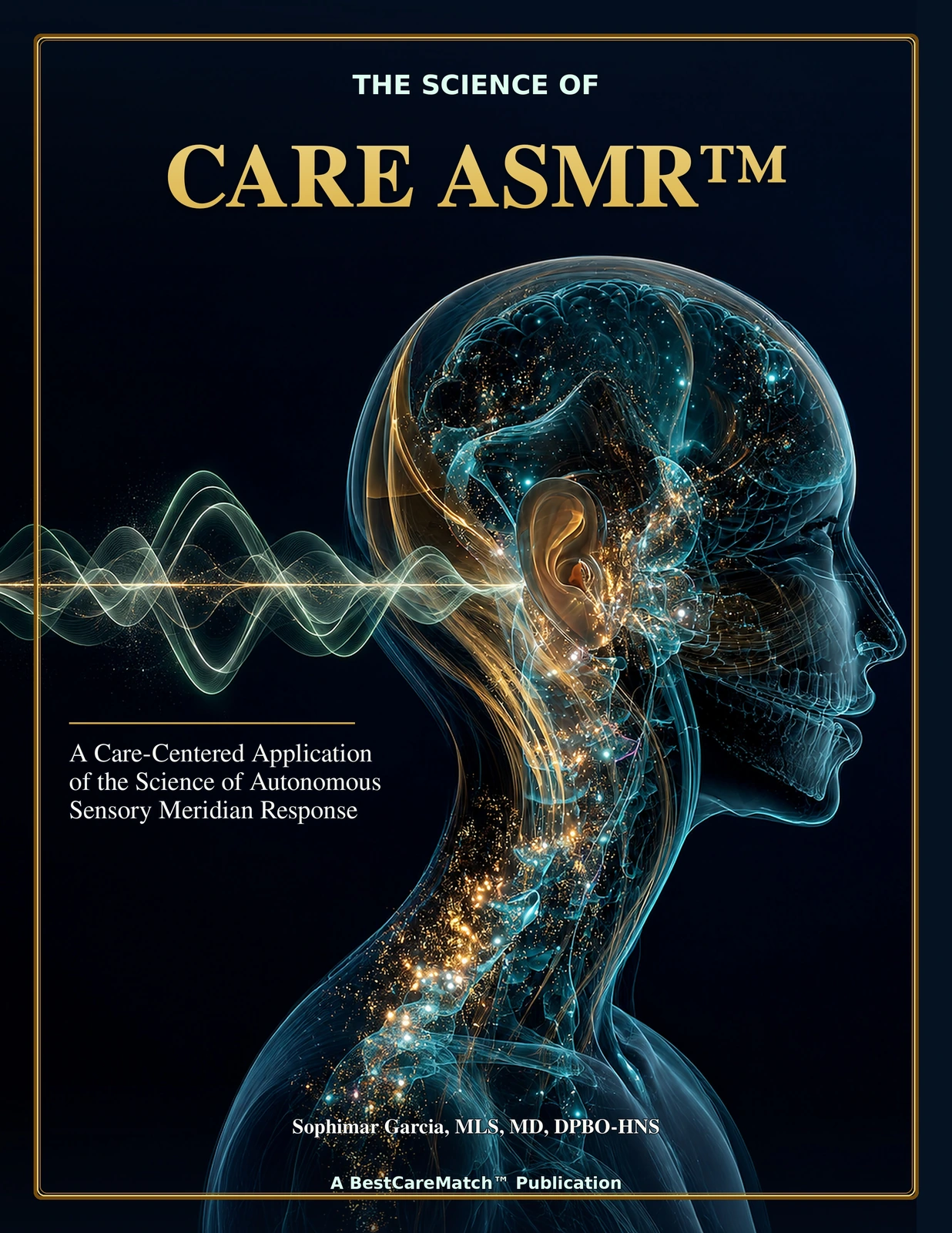
Understand what ASMR research supports and where questions remain, through six parts and 13 conceptual figures.

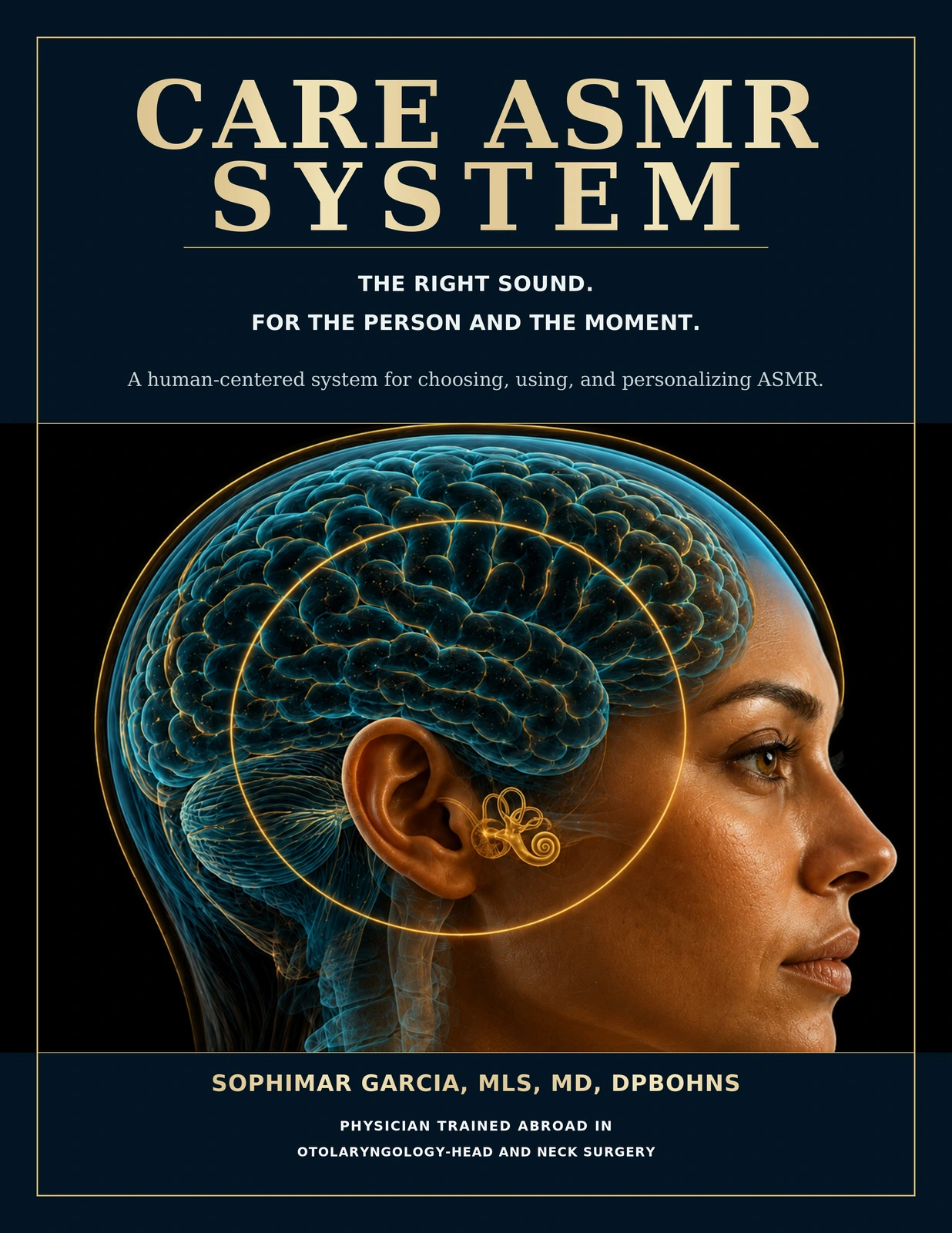
Choose what to try, record what you notice, and decide when to continue, adjust, or stop. Includes the MATCH Method and response tools.

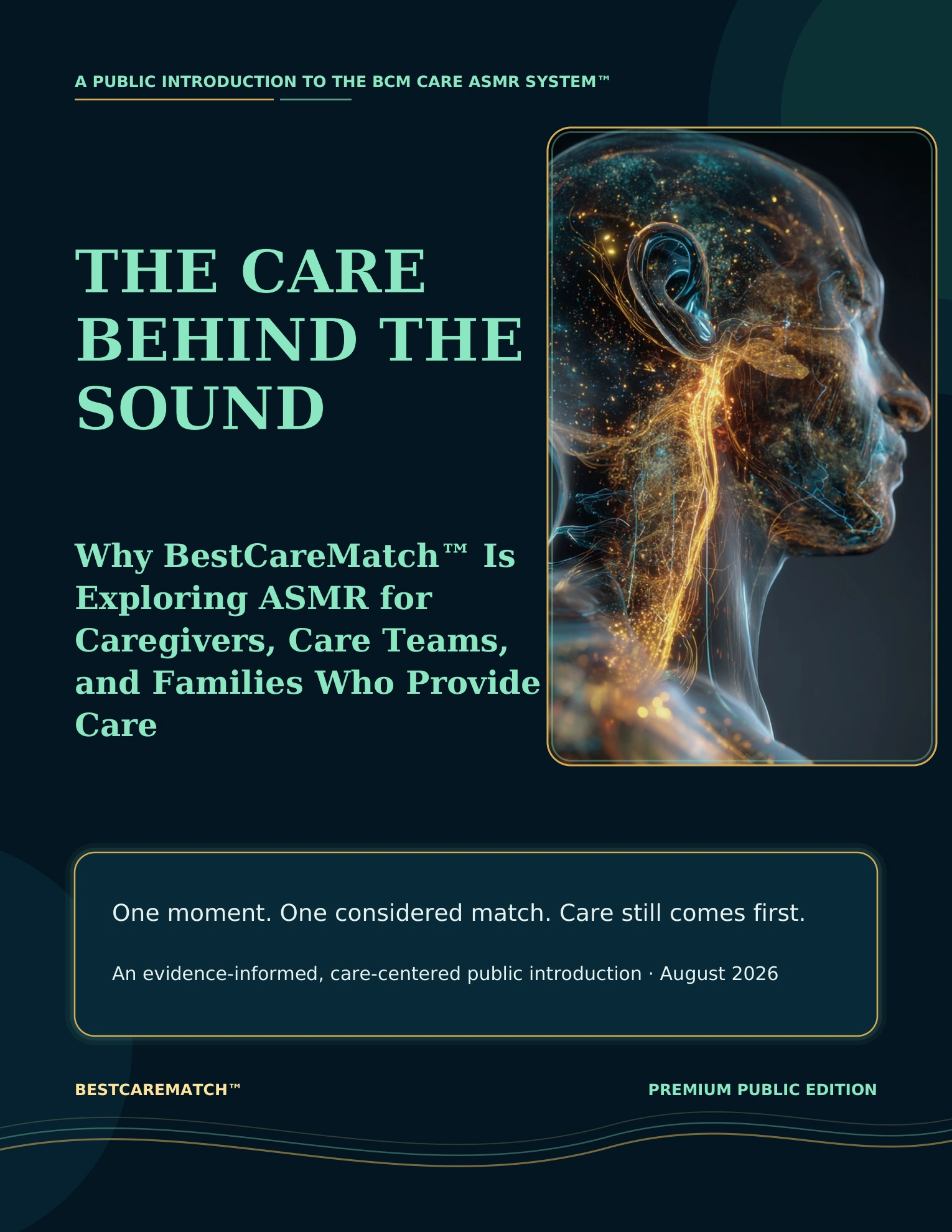
See how preferences, consent, and sound sensitivity shape a sensory pause in this illustrated introduction for families and caregivers.
ASMR means autonomous sensory meridian response: a pleasant tingling sensation some people feel, often around the scalp or neck, in response to sounds, gentle movements, or personal attention. An ASMR trigger is a cue that brings on that response. Whispering, tapping, and slow hand movements are common examples. Responses differ; tingles are not a requirement for enjoying a quiet moment. Explore the research ↓
Natural sound, objects, tapping, paper, fabric, water, texture, rhythm, and no-talking experiences.
Soft speech, whispering, stories read aloud, gentle explanations, and the feeling of being spoken to with care.
Our music-led visual series: short scenes of warmth, gentle humor, and quiet pauses. CALM is a companion series; feeling calm is one possible personal response.
Careful hands, precise movements, arranging, drawing, preparing, grooming, and close-up activity.
Hair brushing, grooming cues, attentive interaction, touch-related imagery, and focused human presence.
The texture of a page, a quiet reading space, familiar images, and surrounding sounds. Explore how several sensory details can come together.
Some people notice tingles. Some notice calm without tingles. Others come for comfort, focus, rest, sensory pleasure, connection, or simple enjoyment.
Choose what you would welcome in this moment, then notice your response. If you are supporting a family member or someone in your care, their preferences lead the choice.
The ear, the sound, the movement, the pause, the attention. Human ASMR can be subtle without being empty.


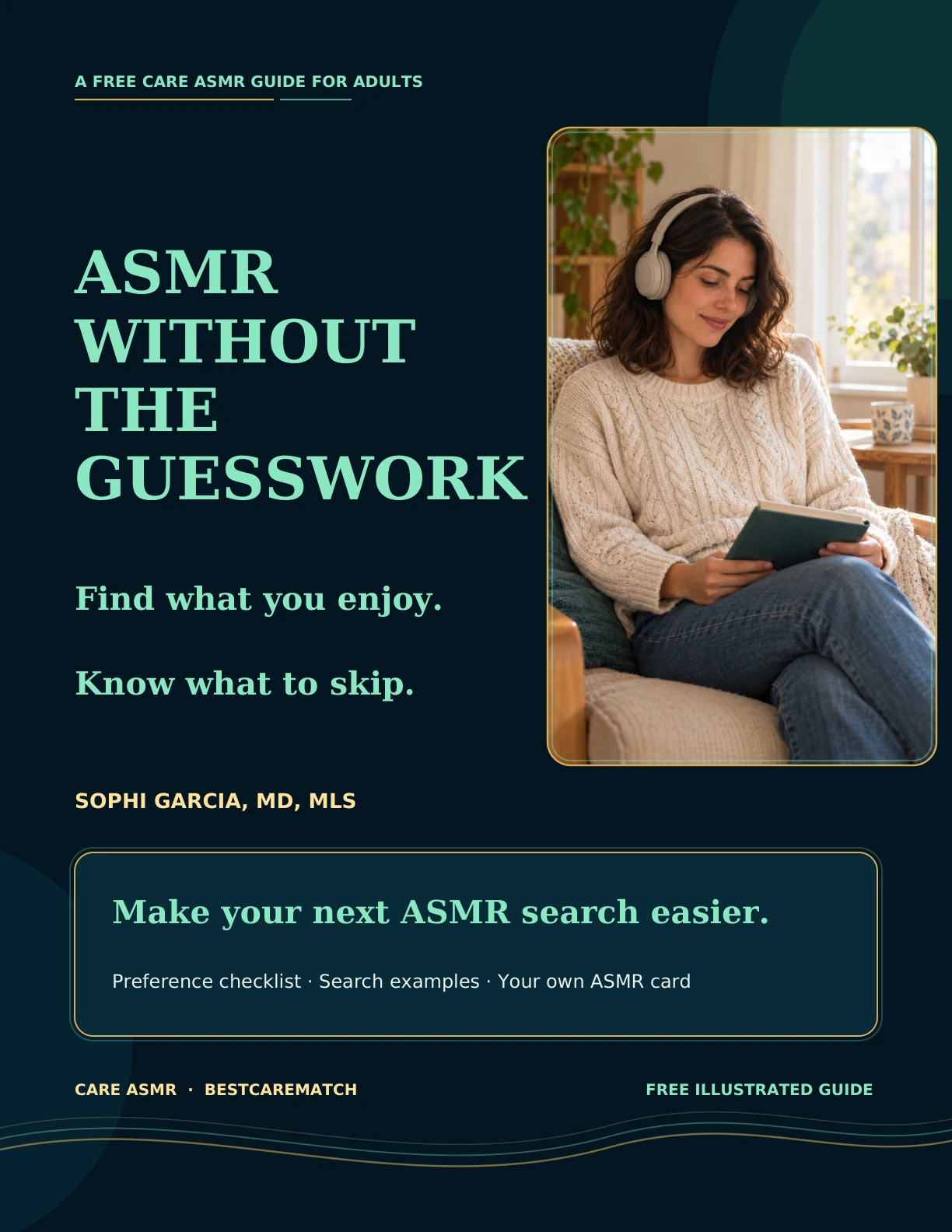
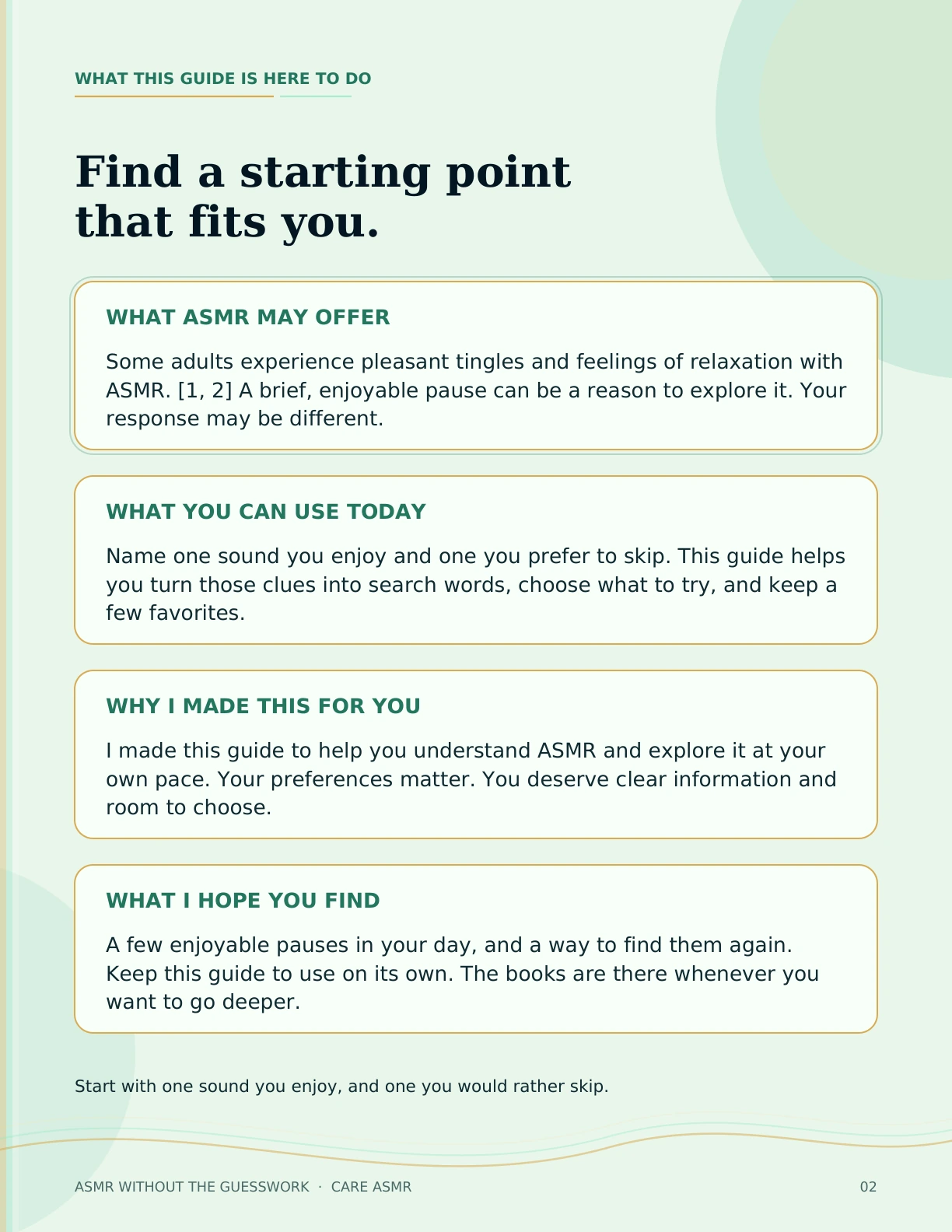
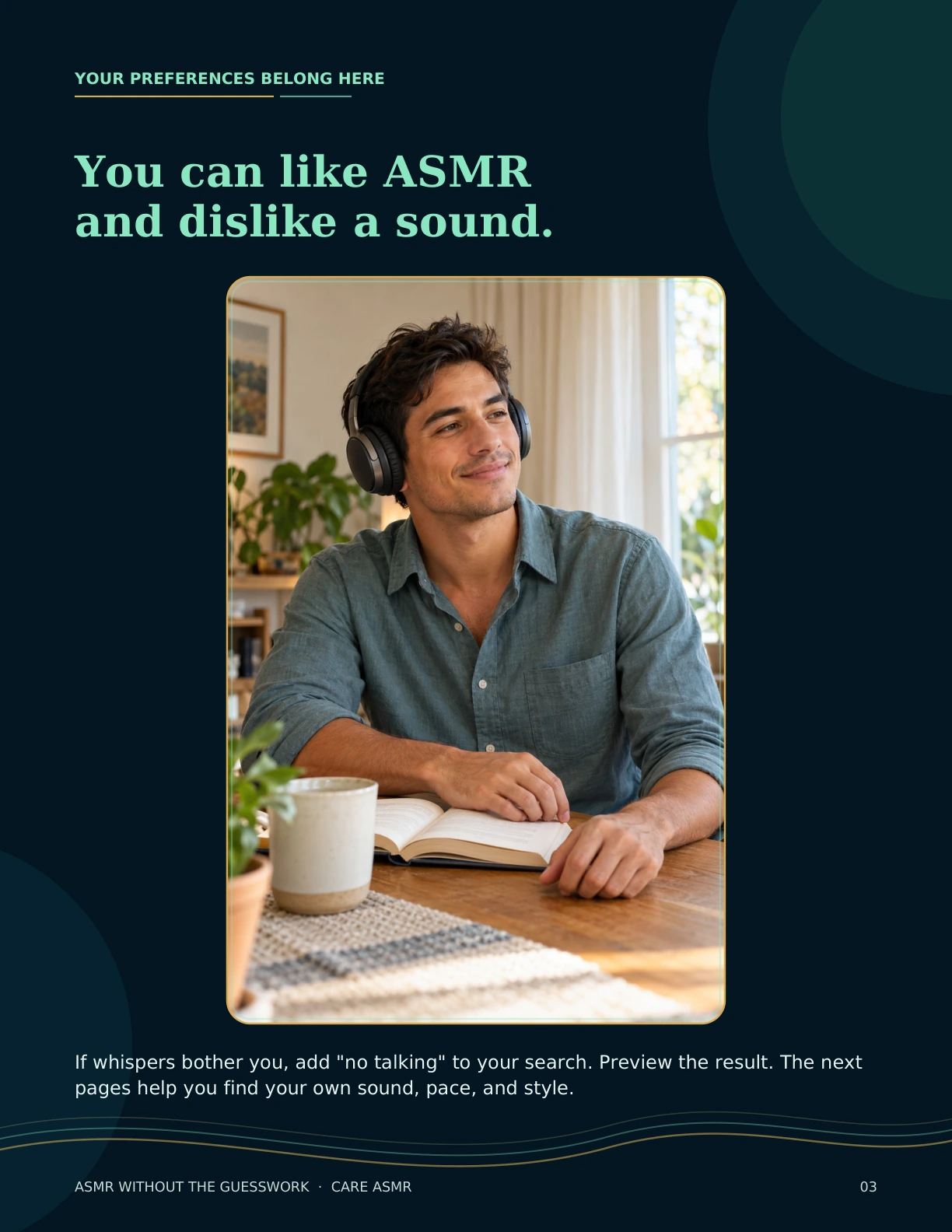
Find what you enjoy. Know what to skip. Start with your preferences, find useful search words, and keep a few favorites. Includes a preference checklist, help with unwanted sounds, and a fillable card to keep.
Read the first 3 pages freely. Enter your email to continue reading and download all 14 pages.
Open here on CARE ASMR. Future email updates are optional.

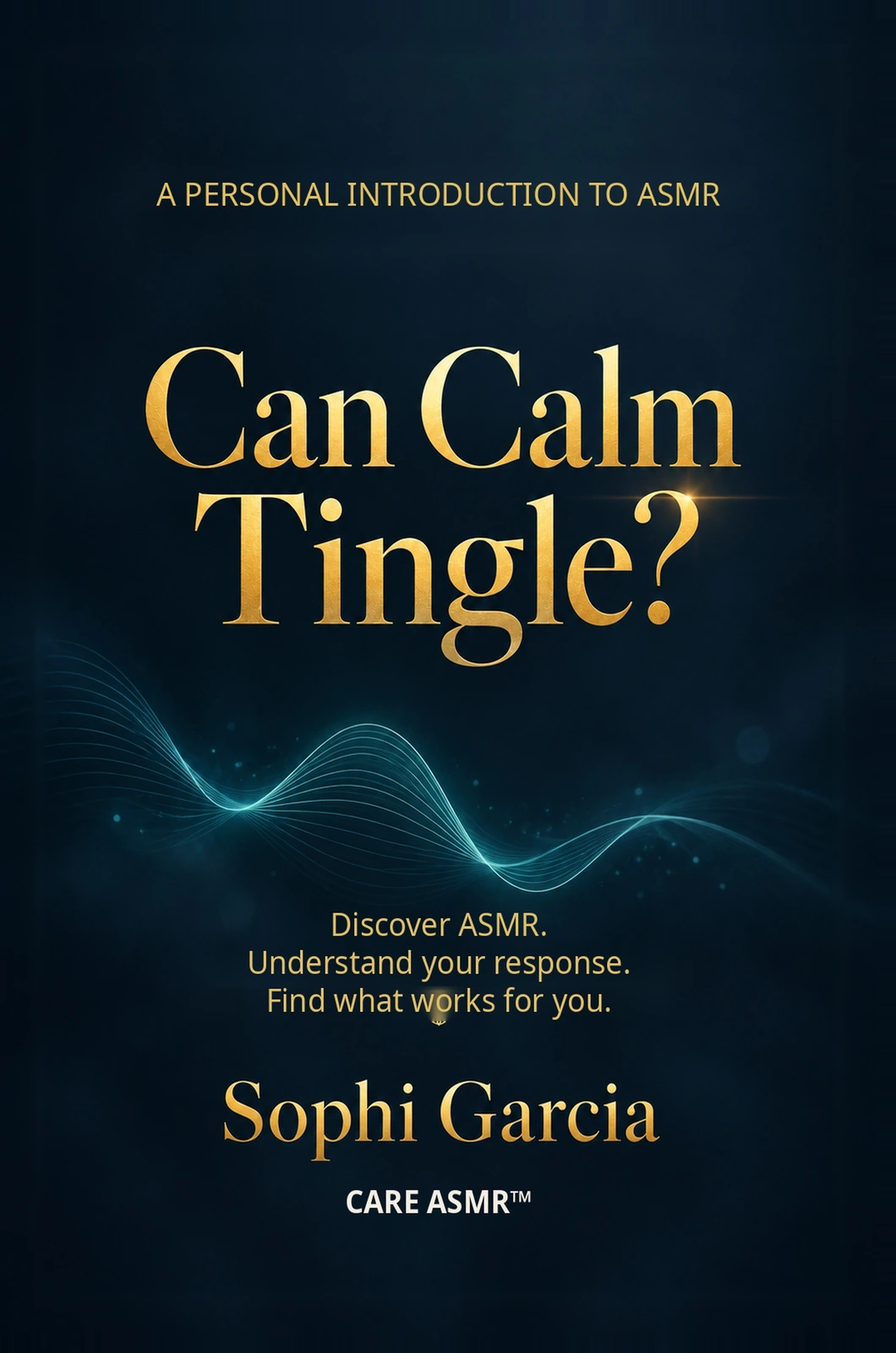
A Personal Introduction to ASMR. Explore calm, tingles, and the small sensory moments that may feel different from one person to another. An illustrated starting point for your own curiosity.
Select an image to see it in full.
Available as a Kindle eBook and paperback on Amazon.

Follow sound through hearing, perception, and the body and brain. Six parts and 13 conceptual figures help you understand the research, recognize its limits, and see why individual responses matter.
Select an image to see it in full.
$37 USD · 117-page digital PDF · Sold by BestCareMatch.
Questions about a book or your download? hello@careasmr.com

Choose what to try, notice the person’s response, and decide what comes next. The MATCH Method gives you five steps: Make the moment safe; Ask or observe; Try one match; Check the response; Honor the response. Use the First Match Card, Personal Match Map, and response records for yourself or someone you support.
Select an image to see it in full.
$57 USD · 152-page digital PDF · Sold by BestCareMatch.
Questions about a book or your download? hello@careasmr.com

Meet CARE ASMR before choosing a paid book. This illustrated introduction explains how preferences, consent, and sound sensitivity shape a sensory pause, with a Care Pause Safety Check for families, caregivers, and care teams.
Select an image to see it in full.
Read online free · Enter your email for the PDF download.
| Choose by your question | Can Calm Tingle? | The Science of CARE ASMR | CARE ASMR System | The Care Behind the Sound |
|---|---|---|---|---|
| Best starting point | New to ASMR or curious about tingles and calm | Want the evidence and its limits | Want a method for choosing and responding | Support someone else and want a free introduction |
| Format | Kindle eBook & paperback | 117-page digital PDF | 152-page digital PDF | Free online reader & 25-page PDF |
| Core purpose | Explore the experience | Understand the research | Apply the MATCH Method and decision system | Meet the CARE ASMR idea |
| Where to get it | Amazon ↗ | Discover on BestCareMatch ↗ | Discover on BestCareMatch ↗ | Read free ↗ |
A 2018 laboratory study found that people who experienced ASMR had a lower heart rate and higher skin conductance while watching ASMR videos. These short-term changes help explain why the sensation is worth studying; they do not establish a treatment or a result for everyone. Read Poerio and colleagues’ study.
A 2025 systematic review of 28 studies found that differences in study design, incomplete data, and reliance on self-reported experiences limit how widely the findings can be applied. Read the review by Ortega-Balderas and colleagues.
The Science of CARE ASMR explores sound, hearing, and the evidence across 117 pages. Choose it when you want to understand the research and the questions that remain.
ASMR is studied as a sensory experience, not as a guaranteed outcome.
Voice, watching, personal attention, visual movement, tactile cues, and multisensory combinations can matter too.
Welcome, neutral, uncertain, absent, and unwelcome responses all matter.
The early Barratt and Davis study (2015) describes the sensation and commonly reported triggers. It is a useful starting point for understanding how ASMR research began.
The books do not diagnose, treat, cure, or prevent disease and do not replace individualized professional guidance.
ASMR stands for autonomous sensory meridian response. It describes a pleasant tingling response to certain sounds, sights, or attentive interactions. The term is also used for videos and audio made to evoke that experience. Explore ASMR and common triggers.
Examples include whispering, soft speech, tapping, page turning, careful hand movements, and personal attention. A trigger that appeals to one person may feel neutral or unpleasant to another. Start with something you already enjoy.
Not everyone experiences ASMR, and no trigger works for everyone. You may still enjoy a quiet voice or a gentle visual scene. There is no need to force a sensation or keep watching something you dislike.
Some adults explore ASMR as a personal way to unwind. An enjoyable sound or quiet visual activity can be one part of a wind-down routine. The studies linked here describe short-term responses in some people who experience ASMR; they do not establish that ASMR stops overthinking. Our free adult guide helps you choose what to try and notice your own response.
Some people use ASMR videos to wind down before bed. That personal use is different from evidence that ASMR treats insomnia. Research has limitations, and better sleep is not a guaranteed outcome. See what ASMR research can tell us.
Your preferences can include both sounds you enjoy and sounds you want to avoid. Skip an unwelcome sound rather than pushing through it. Our free adult guide helps you describe your preferences and choose more useful search words.
Try ASMR Without the Guesswork, a free 14-page guide for adults exploring their own preferences. Read the first three pages, then enter your email to read or download the complete guide. Can Calm Tingle? offers a longer illustrated introduction on Amazon. If you support someone else, The Care Behind the Sound is a free guide for families, caregivers, and care teams.
Choose The Science of CARE ASMR. It is the science-only 117-page publication and specifically separates current evidence from claims the research cannot support.
Choose CARE ASMR System. It is a 152-page guide with the five-step MATCH Method, preference tools, response records, and guidance on when to continue, adjust, or stop.
Everyone responds differently. These books help you understand ASMR and explore your preferences; they cannot promise a particular result.
BestCareMatch brings together educational books and practical systems for understanding care and supporting everyday well-being. CARE ASMR shares that purpose by exploring sound, personal preferences, and the care behind each experience, whether you are exploring for yourself or supporting someone else.
CAREASMR.com is your place to explore the books, science, and sound experiences. When you choose The Science of CARE ASMR or CARE ASMR System, our BestCareMatch store handles your PDF purchase and download. You can buy either book on its own.
The Science of CARE ASMR is a 117-page digital PDF for $37 USD. CARE ASMR System is a 152-page digital PDF for $57 USD. Their buttons open the matching book page on BestCareMatch, where you can review the details and complete your purchase.
Can Calm Tingle? is available as a Kindle eBook or paperback on Amazon. Its buttons take you to Amazon to check the current price and choose your format.
This guide is written for families, caregivers, and care teams. You can read The Care Behind the Sound online without signing up. For the 25-page PDF, enter your email and download it here on CAREASMR.com. Email updates are a separate, optional choice.
Write to hello@careasmr.com for questions about CARE ASMR books, the free guide, or your PDF download. This is your CARE ASMR contact even when your purchase is handled by BestCareMatch.

Can Calm Tingle? is the easiest entry point. Go deeper into the science when you want evidence. Move into the System when you want a repeatable way to choose.